

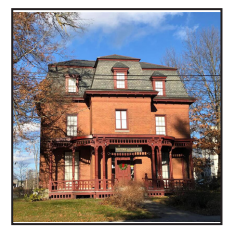
Originally, “The Brick House,” considered “one of the finest residences in town,” was a two-story Italianate house with a flat roof and three square porches in front supported by fluted white pillars. It was built c1851 by Joseph Perry Childs, a Greenfield brick mason who also built the Taylor-Russell House at 40 High Street and the front section of Fay-Griswold House at 51 Church Street. Childs built a number of cisterns in the neighborhood, including the brick cistern on the east side of the house.
In October 1853, Childs sold the house to Thomas Wait for $5,500. For several decades Thomas Wait was a freight hauler. He made two to three trips to Boston every month, bringing agricultural products and returning to Greenfield with hardware and manufactured goods. When the advent of the railroad made the use of horse-drawn teams unprofitable, Wait formed a series of wholesale and retail grocery firms in the 1850s, and continued to offer Boston express service for people desiring to ship goods to the city. His ventures were fluid and the firms dissolved and reformed frequently.
The Wait family owned “The Brick House” for twenty-nine years. Thomas built a barn on the northeast corner of the lot which was later moved to library trustee Delia Nims’ property on Union Street. He planted many beautiful trees, including a row of maples on the east side of Union Street and a row of elms near the eastern boundary of the property. He also embellished the lot with ornamental shrubs and fruit trees. His wife, Louisa Elizabeth, cultivated formal gardens known for their beauty and variety.
In February 1883, six years after her husband’s death, Louisa Elizabeth sold the property to John Edward Devlin, a wealthy, cosmopolitan, retired New York shipping merchant. Although John Edward only lived in the house for five years before his death in 1888, the house was in the Devlin family for nineteen years.
John Devlin undertook substantial renovations. In 1883, he hired George A. Fuller, who at that time was working for Peabody and Stearns in Boston, to renovate the entire roof to its present mansard form. Three years later, Fuller resigned the back ell and the front porch. The Massachusetts Historical Commission Reconnaissance Survey says that the house is “significant for its straight-profile mansard roof, the earliest example known in town.” His wife, Martha Josephine, cultivated over fifty varieties of roses. Her 250 rosebushes included very rare European varieties.
In June 1901, William Gould (W. G.) Packard, a prominent Greenfield banker, bought the house by foreclosure from the Devlins’ granddaughter, Marjory Standish Devlin, who had inherited the house. The Gould family lived in the house for several years, until their fortunes changed and they moved to Washington, D.C.
W. G.’s father, R.A. Packard, ran a private banking house in Greenfield, and then established Packard National Bank, which was chartered in 1875. W. G. was cashier of PNB from 1885 to 1894, and then, after his father’s death, became President of the bank in 1895. On October 1, 1903, Packard National Bank closed its doors. Two years later, Frank Oren Wells, founder of Greenfield Tap and Die Corporation and owner of the Weldon Hotel Company, bought the Packard house at auction for $10,000. In 1907, the Gould brothers filed for bankruptcy in Boston.
F. O. Wells intended to build an apartment building on the Packard property similar in style to the Weldon Hotel, which was converted into an apartment house in 1907. He envisioned a 16-suite building with three entrances and the creation of a park or garden on the east side of the house. Wells intended to sell the main house and remove the Wait barn and perhaps also Devlin’s 1886 ell. His plans, however, fell through, and between 1905 and 1909, he advertised furnished rooms for rent. “The Brick House,” home to three prominent Greenfield families from 1852 to 1905, saw a period of decline. Its beautiful gardens and meticulously maintained interior fell into disrepair.
Concerned about the preservation of Greenfield’s history, Mary Prudence Wells Smith founded the Greenfield Historical Society (now the Historical Society of Greenfield) on June 26, 1907. For several years, the Society met in her house at 33 High Street. Their fortunes changed in 1910 when Edward Benton, Register of Deeds and highly respected local historian, bequeathed $5,000 to the Society which allowed them to look a permanent home for the organization. In four years, the members raised an additional $3,000. On March 14, 1914, F. O. Wells conveyed 43 Church Street to the Greenfield Historical Society. Later that year, they held their annual meeting in Benton Hall, which today serves as the Historical Society of Greenfield’s main exhibition space.
Our FB page